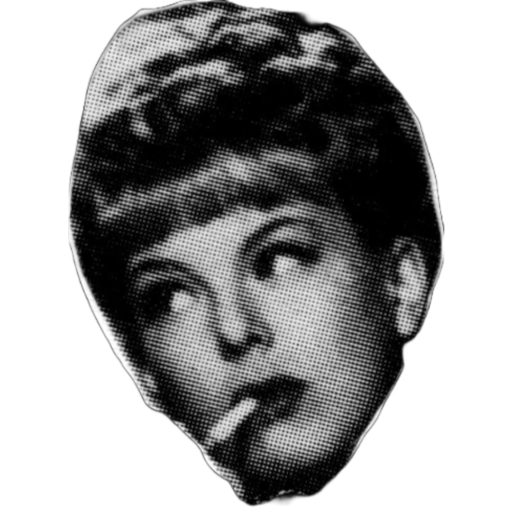

As soon as I received the first treasure map in the post, I knew it was from Kathy and that she wanted me to come find her. She has been dead for a while, but I never stopped believing that one day I might sit down with her to share a drink and listen to her talk the way I had seen in old videos: eloquently, mystically, with a glint called malice sparkling in her eye.
As Neil Gaiman put it in his preface to Pussy, King of the Pirates, ‘I miss Kathy because I forget she is dead.’ This is precisely the trouble of remembering and forgetting. I, too, miss Kathy, though I did not really know her in a literal sense, only a literary sense. I have been the observer, the occasional bystander in her life. But her life is over. I fold the treasure map and don my best boots to go and meet Kathy at the end of the world.
Kathy Acker was born on April 18, 1947. Or 1948. Or 1944, as it is cited in her obituary in The New York Times. Her birth year is a disputed fact. It cannot quite be pinned down; instead it is speculated upon, reiterated in various forms, birthing a mythology that would go on to bolster the image of a subversive and transgressive writer.
“I tried to run away from the pain named childhood,” Kathy says, echoing the words written in her 1993 novel, My Mother: Demonology.
Born in the late 1940s, she was surrounded by wealth and privilege growing up the daughter of an affluent American-German-Jewish family. Kathy was the master of ceremonies and she insisted on re-reading the same fables over and over, echoing these made-up nursery rhymes that she must have learnt at the Birch Wathen Lenox School, in upstate New York.
Kathy was a loner, a loser, a sexed-up punk lost in a sea of debutantes. There is something comforting in her cynicism. I see her as a turbulent teenager, ripping up manifestos and stumping around the Upper East Side in search of an unmarked copy of Burroughs’ Naked Lunch. She convinces one of the other girls at her stuffy prep school to shave their heads to protest anti-abortionists and together they become pirates. They fall asleep in class to avoid answering stupid questions about Napoleon. Only in English Literature does she sit up straight and pocket her gum.
Her literary influences paved the way for a rabble-rousing and controversial semi-autobiographical oeuvre. She was a pirate, and that’s how she lived, but stealing was not the real aim. She loved to go to the University library in San Diego and pick a line or two from her favourites. The Marquis de Sade, William Burroughs, Charles Dickens and Arthur Rimbaud. Kathy’s work is littered with these names, changed and altered to suit her needs. In her 1982 novel, Great Expectations, she transplants Dickens’ tale of 19th century England into the New York art scene of the 1980s. Her method, a so-called ‘appropriation’, was influenced by the punk aesthetic of the 1970s as well as Beat Generation writers such as William S. Burroughs.
Kathy’s writing has an unnervingly sexual energy. It is all too tempting to be appalled. How easy it would be to give into that blushing surprise, to slam the book shut in horror, only to see her face staring back at you from the cover, mocking your fair weather attitude to sex and sadomasochism. Her spiky head bounding to the techno static, her bare back revealing her bad girl status: tattoos under leather, red lips smacking. She waves a sly flag and back into her words I plunge.
Her writing can be abrasive, sexually subversive, and often nonsensical. There is beauty in the grotesque treatment of characters, who seem at once exploited and liberated by their own sexual desires and the sexual desires of others. Like the protagonist, Janey, in New York City in 1979, stalking around Manhattan in ‘pleated black fake-leather pants [which] hide her cocklessness… two round prescription mirrors mask the eyes.’
Her work was, and still remains, controversial. Arguably her most famous work, Blood and Guts in High School was even banned in Germany and deemed: “harmful to minors”.
I recall talking about Blood and Guts in High School, with a friend from University who could not understand why I liked it.
“It’s just awful,” she said, telling me how she had been unable to get past the first thirty pages.

Kathy’s writing is also full of violence, of hate. I wondered what she thought that said about me. Writer Chris Kraus admired Kathy Acker and wrote a literary biography in 2017, After Kathy Acker.
“Acker”, writes Kraus in her 2006 semi-autobiographical novel, Torpor, “understands that writing, without myth, is nothing and female myths don’t run in groups. They’re always singular.”
Kathy was one of few female writers accepted into this small, predominantly male, postmodern scene. Like many of her characters, Kathy Acker’s public image, this self-constructed mythology, was at once male and female. According to Kraus, it was Acker’s lack of commitment to the kind of rallying feminism that made her an unreachable and prized figure in the literary world, though notably at the expense, perhaps, of solidarity. It meant isolation, a distancing from friends and peers. Kathy Acker was a singular mythology.
I am suddenly, acutely aware that there exist so many Kathys, in so many rooms, and that all of them are dead.
The state of her declining health haunts me. The rotten, clumped lung stinking up the place like cancer. I can’t bare to imagine it: the alternative medicine bottles, the yellow wallpaper, a dying Kathy with no breasts and hundreds of purple gardenias.
Kathy died in Room 101 of a Tijuana cancer clinic, on November 30, 1997. She was 50 years old. She died before I was born, before I even had the chance to call her up and ask her about Janey, and yet- she is still planting seeds like ideas. She takes my hand and leads me along the unfamiliar path. We pass them all, her cut-up selves: Janey, Silver, O and Ange, Pussy, King of the Pirates.
I turn the page and we become dancers, Kathy and I. She lives on, perhaps, because her myth fed on the fractured relationship between women writers and the desire to be known. She lives on, perhaps, because her writing conveys something tangible and true about desire and writing and the construction of a postmodern self. Her body may be rotting and inconsolable, but her heart, I know, is still pure and full of stories.
Extract from ‘Look Who’s Come to Dinner: Kathy Acker’, The Head of a Woman, Issue 01